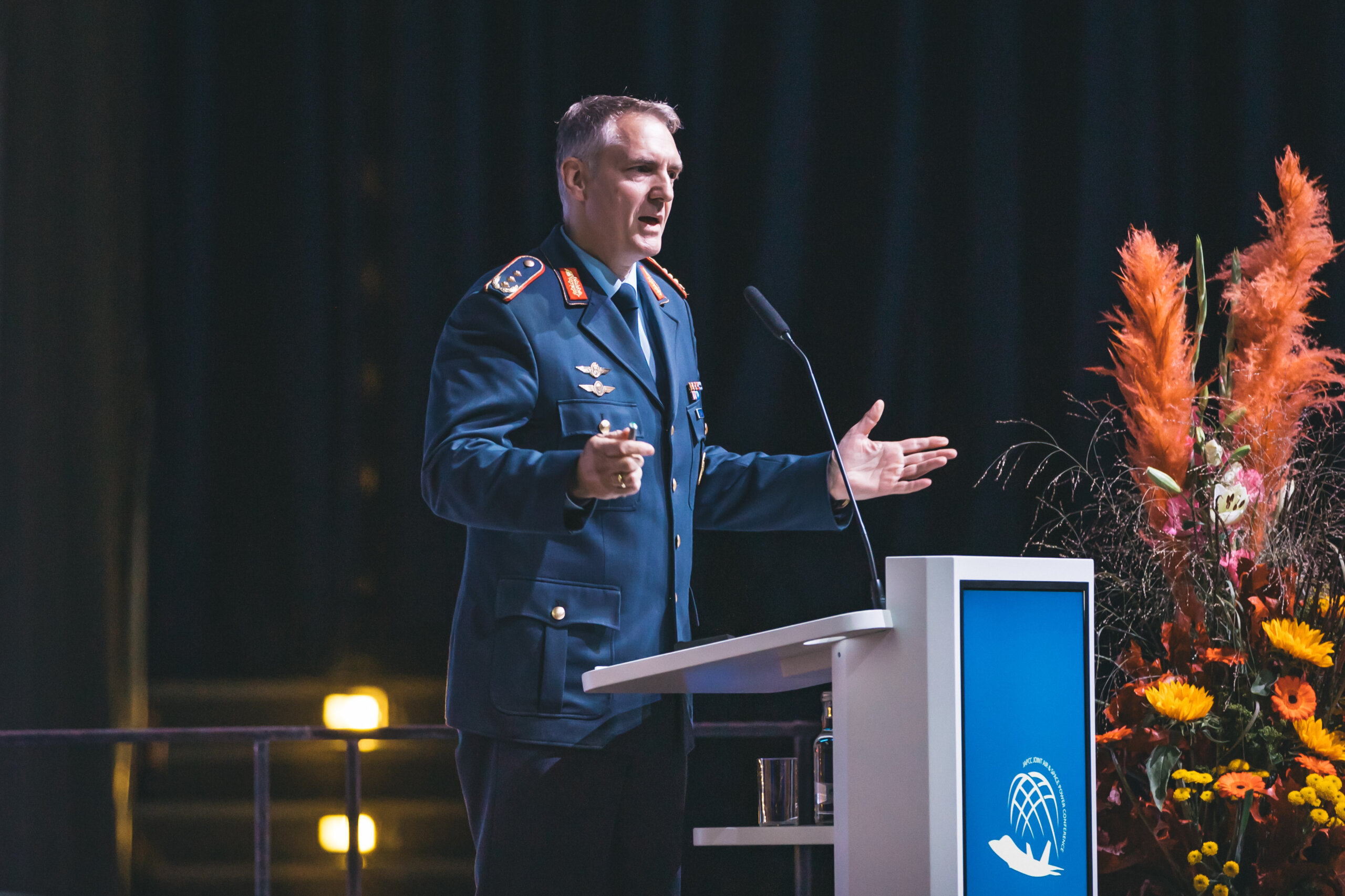
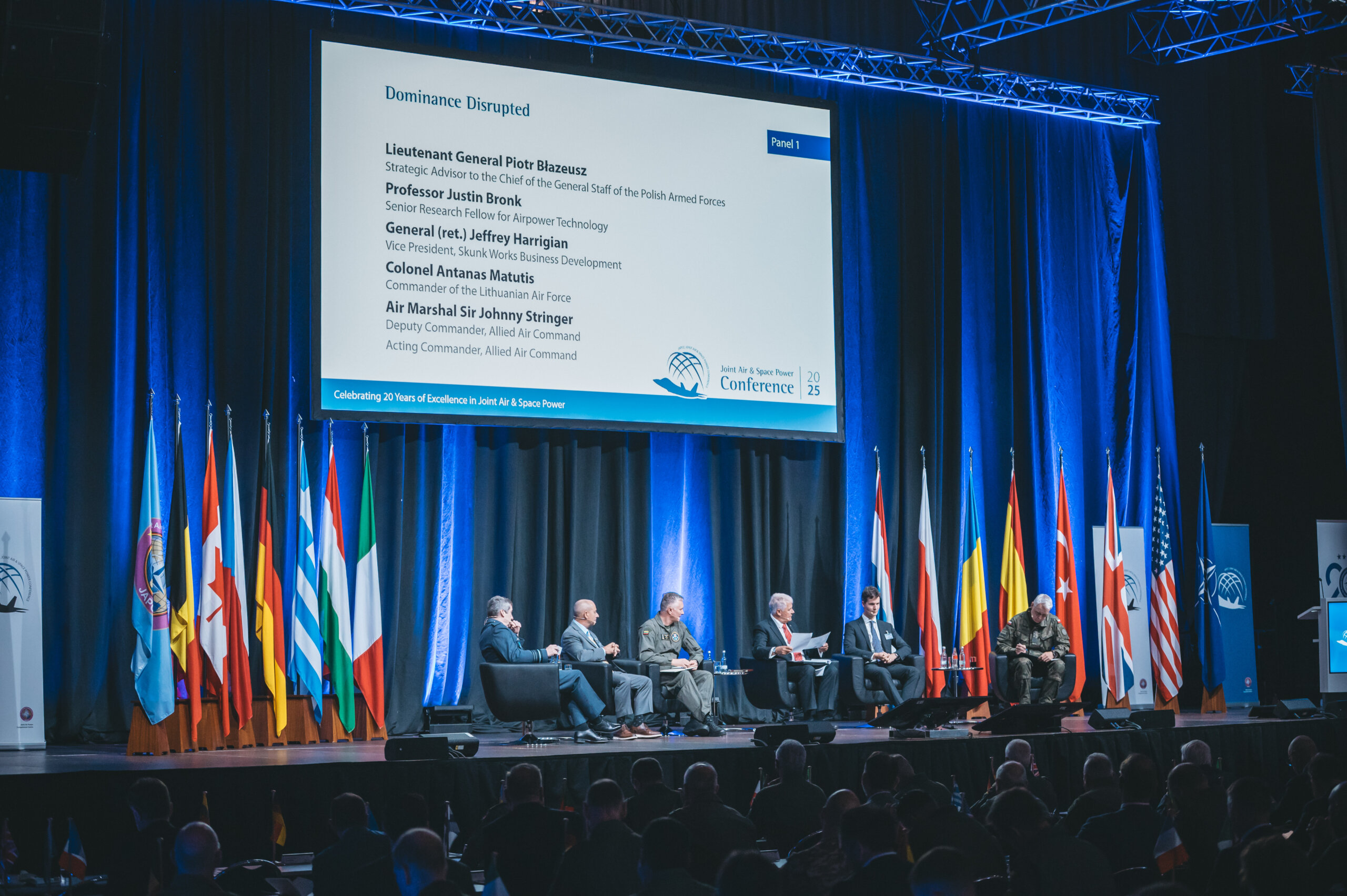
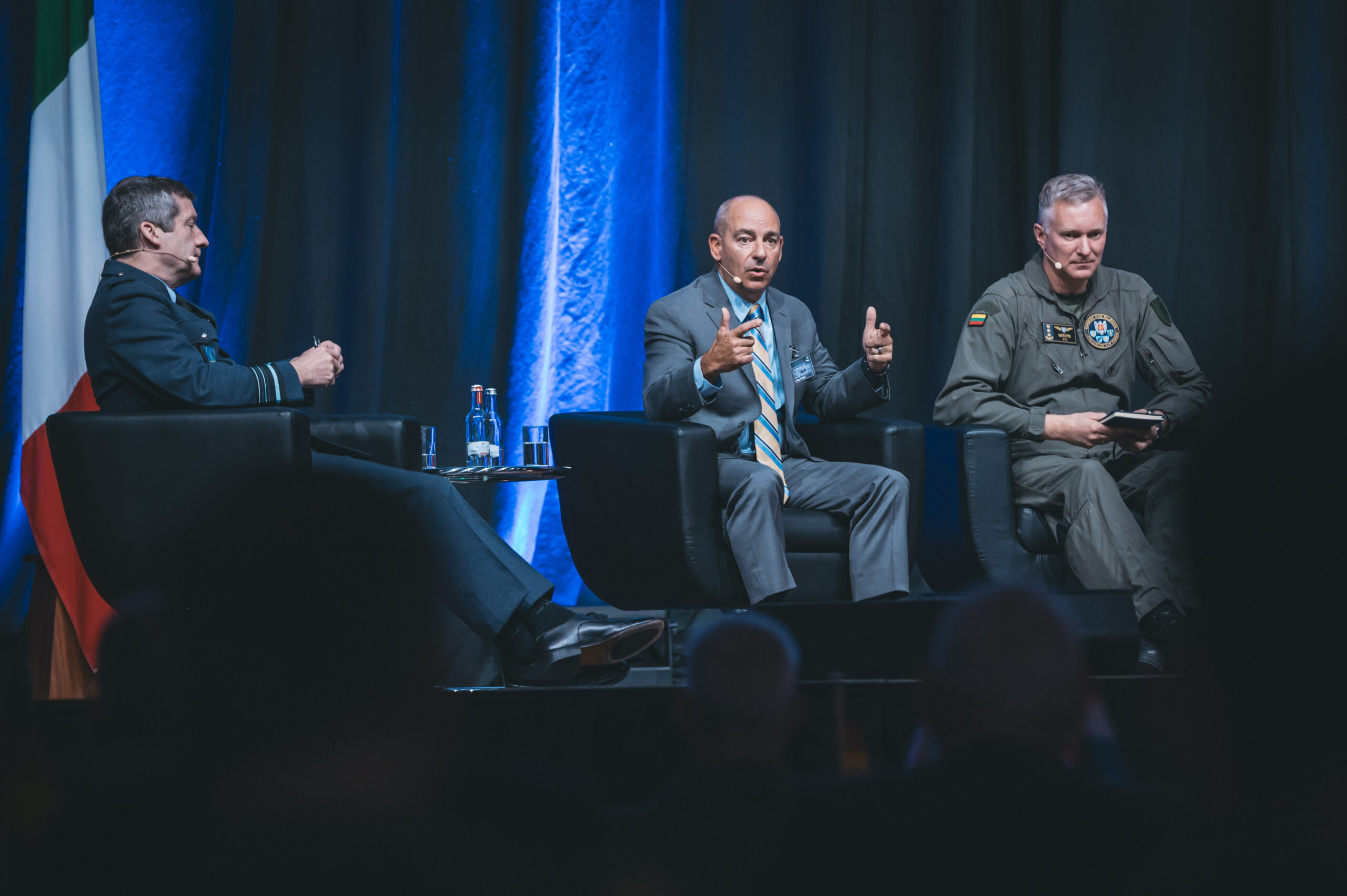
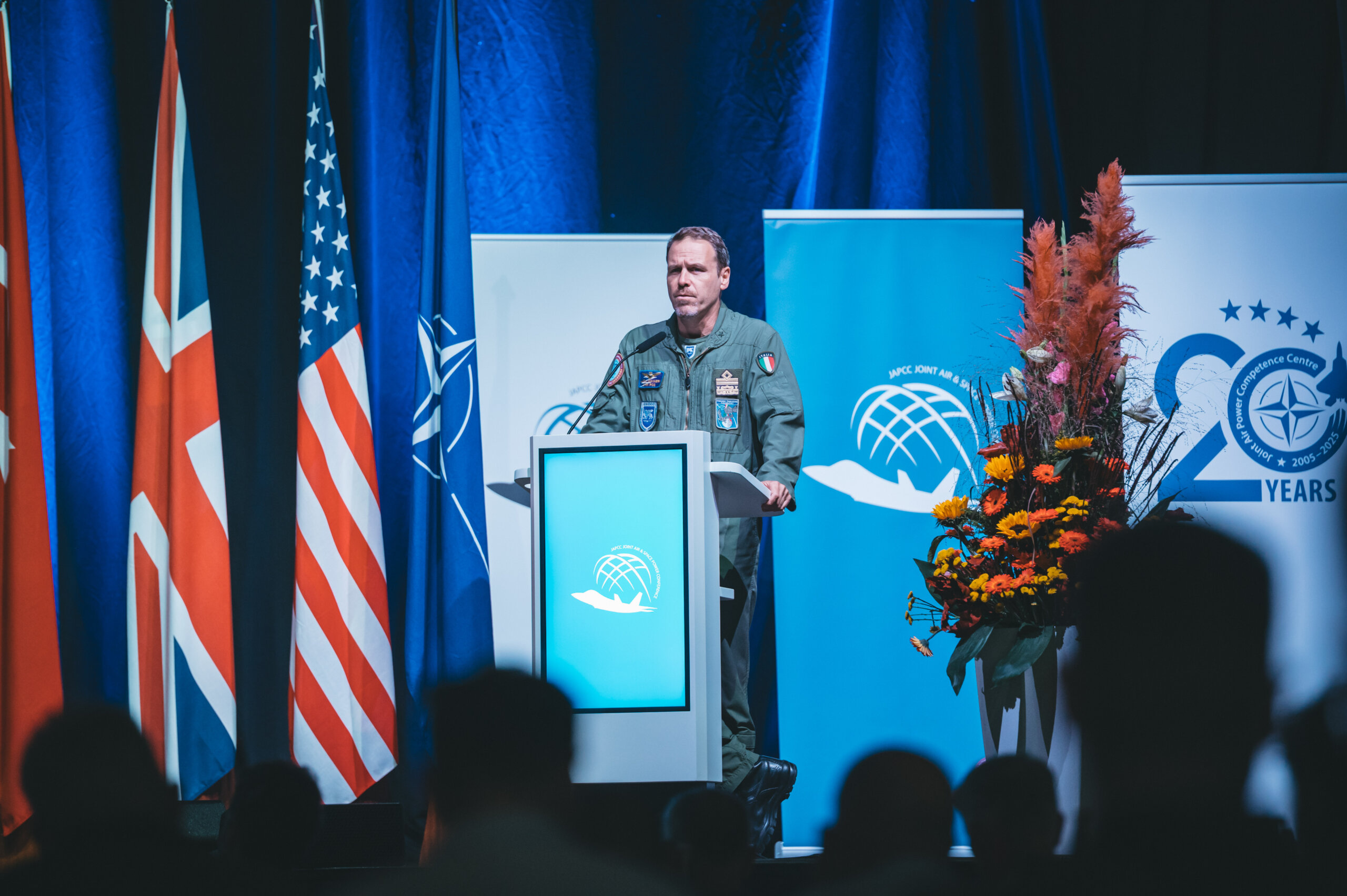
Joint Air and Space Power Conference 2026
22-24 September 2026
Grugahalle Essen

Air Power at the Edge: Securing NATO’s New Frontiers
We cordially invite distinguished delegates, stakeholders, and experts in the field of Joint Air and Space Power to attend our annual conference, which will take place from 22 to 24 September 2026 at the ‘Grugahalle’ in Essen, Germany. This event offers a forum to explore the theme of ‘Air Power at the Edge: Securing NATO’s New Frontiers’.
Strategic competition is no longer confined to traditional battlefields; it is expanding rapidly into the High North, the Indo-Pacific, the orbital commons, and the human cognitive domain.
The 2026 Conference, Air Power at the Edge: Securing NATO’s New Frontiers, invites an expanded view of the air and space domain—one that recognises the interconnected nature of capability development, operational credibility and international cooperation. The conference challenges the Alliance to look beyond the immediate Eastern Flank and confront these emerging realities. NATO must secure a 360-degree deterrence posture that bridges new geographic, technological, and human frontiers, maintaining a sharp edge on each.
In line with this theme, this year’s discussions will address a broad range of strategic and operational topics shaping the future of air and space power. These include how shifting geopolitical dynamics and emerging areas of competition are reshaping deterrence and defence requirements; how civil and military actors can work more effectively together to address cross-domain challenges; how air and space power can contribute to security and resilience in the grey zone below the threshold of open conflict; and how advances in technology, training and human–machine interaction are redefining the skills, structures and concepts needed for future forces. This conference will help forge the roadmap for that evolution, exploring how we can master these new realities to secure NATO’s new frontiers and maintain the Alliance’s edge.
The 2026 Joint Air and Space Power Conference provides a forum to address these complex challenges. Participants can look forward to a comprehensive two-day programme featuring intellectually stimulating panels, thought-provoking sessions, and active engagement and networking opportunities.
Conference Panels
Panel 1
NATO’s 360º View: Flanks, Fronts, and Frontiers
This opening panel frames NATO’s 360-degree challenge by examining the flanks, fronts, and frontiers most likely to shape the future security environment. While the Eastern Flank remains a critical focus, the Alliance faces growing strategic pressure across evolving boundaries—geographic, vertical, digital, and cognitive. From the High North and the Southern approaches to the Indo-Pacific, and from near-space to contested data, energy, and logistics networks, these challenges present distinct threat dynamics, operational constraints, and political sensitivities. This reality demands a prioritised approach to air and space power posture, readiness, and capability.
The discussion will focus on the central role air power plays in deterrence, situational awareness, and strategic reach with an expanded view of the security environment. It will also examine how air power is specially situated to counter potential threats, instability, and malign influence that impact Alliance security from outside the region. In particular, the panel will examine the High North, where harsh environments, vast distances, and limited infrastructure and communications challenge early warning, domain awareness, and sustainment—testing both human performance and technological resilience.
To conclude, the panel will confront the core dilemma of a 360 posture: balancing competing regional priorities against finite national capacity. It will examine how NATO aligns differing threat perceptions and sustains readiness across multiple, interconnected fronts simultaneously, setting the strategic foundation for the conference and framing a central question: what must air power enable first?
The discussion will focus on the central role air power plays in deterrence, situational awareness, and strategic reach with an expanded view of the security environment. It will also examine how air power is specially situated to counter potential threats, instability, and malign influence that impact Alliance security from outside the region. In particular, the panel will examine the High North, where harsh environments, vast distances, and limited infrastructure and communications challenge early warning, domain awareness, and sustainment—testing both human performance and technological resilience.
To conclude, the panel will confront the core dilemma of a 360 posture: balancing competing regional priorities against finite national capacity. It will examine how NATO aligns differing threat perceptions and sustains readiness across multiple, interconnected fronts simultaneously, setting the strategic foundation for the conference and framing a central question: what must air power enable first?
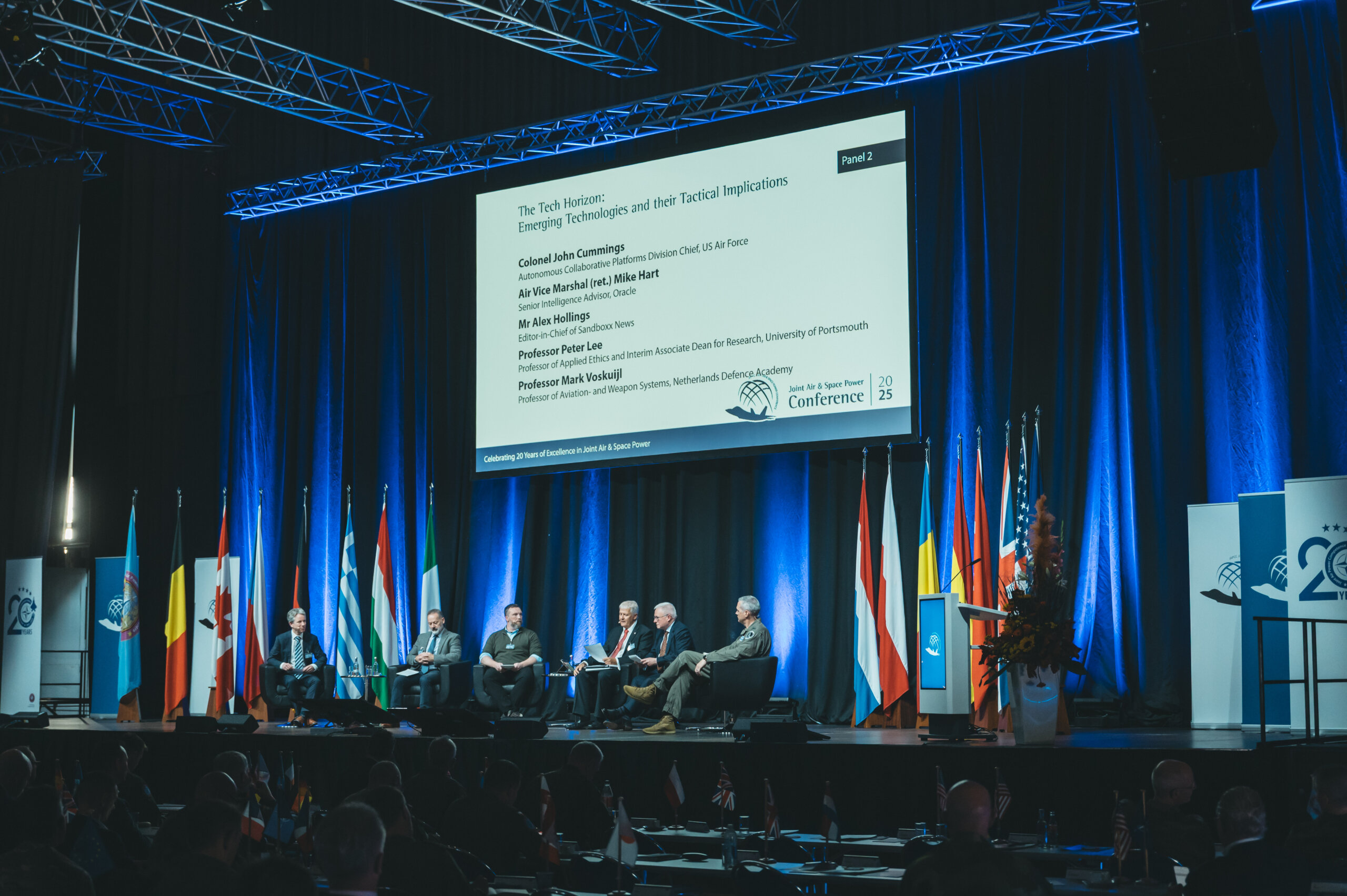
Panel 2
Blue in the Grey Zone: Air Power in Hybrid Conflict
The second panel will examine how air power contributes to deterrence and defence below the threshold of armed conflict—where hybrid tactics exploit ambiguity, deny attribution, and seek to fracture Alliance cohesion without triggering a conventional response. In this “grey zone,” air power and air domain operations aren’t limited to a crisis response option but provide a continuous instrument in strategic competition. The discussion will explore how air power, enabled by multi-domain integration, can sustain persistent presence and situational awareness, enable rapid attribution and exposure of malign activity, and offer calibrated options for signalling and response that support political coherence and escalation management.
The panel will also address the practical constraints that shape air power effectiveness in hybrid competition. Divergent national authorities and rules of engagement, differing interpretations of doctrine and TTPs, and reliance on enabling assets that may sit outside a military commander’s direct control—including commercial space and civilian cyber capabilities—can all complicate timely action. Panellists will assess what posture, platforms, munitions, training, and command-and-control adaptations are required to keep decision advantage and operational credibility in a domain defined by persistence, speed, and narrative. Above all, the discussion will focus on how NATO can employ air power in ways that constrain hybrid actors and actions, reinforce Alliance unity, and protect the integrity of the Euro-Atlantic security space.
The panel will also address the practical constraints that shape air power effectiveness in hybrid competition. Divergent national authorities and rules of engagement, differing interpretations of doctrine and TTPs, and reliance on enabling assets that may sit outside a military commander’s direct control—including commercial space and civilian cyber capabilities—can all complicate timely action. Panellists will assess what posture, platforms, munitions, training, and command-and-control adaptations are required to keep decision advantage and operational credibility in a domain defined by persistence, speed, and narrative. Above all, the discussion will focus on how NATO can employ air power in ways that constrain hybrid actors and actions, reinforce Alliance unity, and protect the integrity of the Euro-Atlantic security space.
Panel 3
The Resilient Edge: Agile Logistics and Infrastructure
This panel examines “the Resilient Edge”: the logistics, infrastructure, and sustainment foundations that allow NATO air power to remain credible in contested, degraded, and operationally restricted environments. As the Alliance broadens its scope to multiple frontiers, it must be able to generate and sustain air domain combat power under pressure, while safeguarding the critical national infrastructure that underpin operational success. In both large-scale conventional and hybrid conflict, the assumption of sanctuary is increasingly fragile: energy supply, transportation networks, and digital connectivity are all potential targets, and the bases and hubs that underpin air operations can be disrupted, isolated, or held at risk.
The discussion will explore what resilience looks like in practice: agile command and control, dispersed operations, and the ability to deploy, support, and sustain forces with reduced footprints and limited infrastructure. Panellists will assess NATO’s vulnerabilities in combat support and force generation, and the adaptations required to recover, reconstitute, and continue operating at pace. Central themes include Agile Combat Employment, modular logistics and prepositioning, Host Nation Support, multinational sustainment, and the renewed importance of Aircraft Cross-Servicing to turn aircraft rapidly with minimal deployed support—so that agility and endurance are built into the system, not improvised in crisis.
The discussion will explore what resilience looks like in practice: agile command and control, dispersed operations, and the ability to deploy, support, and sustain forces with reduced footprints and limited infrastructure. Panellists will assess NATO’s vulnerabilities in combat support and force generation, and the adaptations required to recover, reconstitute, and continue operating at pace. Central themes include Agile Combat Employment, modular logistics and prepositioning, Host Nation Support, multinational sustainment, and the renewed importance of Aircraft Cross-Servicing to turn aircraft rapidly with minimal deployed support—so that agility and endurance are built into the system, not improvised in crisis.
Panel 4
The Human Frontier: Training and Operating at Technology’s Edge
This panel examines the Human Frontier: whether NATO air forces are adapting their people, training, and institutions at the same pace as rapid technological change. As AI-enabled systems, autonomy, and advanced decision-support tools mature, the decisive variable remains the human element. How do we empower warfighters to build trust in machine outputs, recognise bias and manipulation, and retain meaningful control as the tempo of operations accelerates toward machine speed? The discussion will explore how human–machine teaming is changing the demands placed on aircrew, command-and-control teams, and the wider force, and what that means for training, evaluation, and professional development.
The panel will also address a practical reality: many Allies face recruiting and retention pressures. At the same time, the required skill set is expanding. Panellists will consider how NATO members can produce proficient aviators and air power practitioners faster and more cost-effectively without trading away readiness or judgement—leveraging high-quality synthetic training, cognitive tools, and modernised instructional approaches. Finally, the discussion will examine how emerging technologies can be harnessed not only to improve performance, but also to enhance resilience, quality of life, and career longevity—so that the Alliance develops “next-generation capabilities” in both its platforms and its people.
The panel will also address a practical reality: many Allies face recruiting and retention pressures. At the same time, the required skill set is expanding. Panellists will consider how NATO members can produce proficient aviators and air power practitioners faster and more cost-effectively without trading away readiness or judgement—leveraging high-quality synthetic training, cognitive tools, and modernised instructional approaches. Finally, the discussion will examine how emerging technologies can be harnessed not only to improve performance, but also to enhance resilience, quality of life, and career longevity—so that the Alliance develops “next-generation capabilities” in both its platforms and its people.
Conference Speakers
Keynote Speaker

General
Aurelio Colagrande
Allied Command Transformation
Deputy Supreme Allied Commander Transformation
As Deputy Supreme Allied Commander Transformation (DSACT), General Colagrande supports NATO’s transformation agenda, driving innovation, capability development, interoperability, and the Alliance’s adaptation to future security challenges.

Lieutenant General
Antonio Conserva
Italian Air Force
Chief of Staff of the Italian Air Force
Lt Gen Antonio Conserva has held the position of Chief of Staff of the Italian Air Force since May 2025, leading 44,000 personnel in Italy and abroad. He oversees the training, equipment and preparation of the national airspace defence system, in coordination with the Chief of Defence Staff.

Air Chief Marshal
Sir Johnny Stringer
Supreme Headquarters Allied Command Europe
Deputy Supreme Allied Commander Europe
Air Chief Marshal Sir Johnny Stringer has served as Deputy Supreme Allied Commander Europe since March 2026, following a distinguished career in operational command and senior NATO leadership.
NATO’s 360º View: Flanks, Fronts, and Frontiers

Ass. Prof. Dr. iur.
Ian-Tsing Joseph Dieu
Taipei Representative Office in Germany
Director General
Dr. Ian-Tsing Joseph Dieu has served as Director General of the Taipei Representative Office in Munich since 2022, drawing on extensive experience in diplomacy, national security, and international law.

Commander
Dr. Rachael Gosnell
George C. Marshall European Center for Security Studies
Military Professor
Dr. Rachael Gosnell is a U.S. Navy officer, strategist, and Arctic security expert whose operational, academic, and research experience focuses on the evolving strategic and maritime dynamics of the Arctic.

Major General
Timo Olavi Herranen
Finnish Air Force
Commander of the Finnish Air Force
Major General Timo Herranen is an experienced Finnish Air Force commander and aviator with more than 2,500 flight hours and extensive expertise in operational command, strategic planning, and air power leadership.

Lieutenant General
Mauro Lunardi
Italian Air Force
Commander Air Squad and 1st Air Region
General Lunardi is a highly experienced Italian Air Force officer and aviator with more than 2,800 flight hours and extensive leadership experience spanning operational command, defence planning, resource management, and NATO assignments.

Group Captain
Michael Sleeman
Royal Australian Air Force
Australian Defence Attaché to Germany and Poland
Group Captain Michael Sleeman is the Australian Defence Attaché in Berlin and an experienced RAAF pilot and commander with over 4,300 flying hours and extensive operational and strategic-level expertise.

Ms
Radoslava Stefanova
North Atlantic Treaty Organization
Head, Integrated Air and Missile Defence
Radoslava Stefanova heads NATO’s Integrated Air and Missile Defence Section, leading Alliance policy on IAMD, ballistic missile defence, and air policing as key elements of NATO’s deterrence and defence posture.
Blue in the Grey Zone: Air Power in Hybrid Conflict

Mr
Harald Mannheim
Schwarz Digits
Head of Defence
Harald Mannheim is Head of Defence at Schwarz Digits, leading the expansion of its defence business with a focus on sovereign, highly secure digital infrastructure and cyber capabilities for European defence.

Ms
Natascha McVeigh
University of Lincoln
Senior Lecturer in Crisis and Disaster Management
Natascha McVeigh is a defence and crisis-management expert specialising in grey-zone and hybrid threats, critical infrastructure, and space and supply-chain resilience, combining operational German Air Force experience with academic and deep-tech defence expertise.

Major General
Dr. Volker Pötzsch
Cyber and Information Domain Service Command
Major General Dr. Pötzsch is Chief of Staff of the Cyber and Information Domain Service Command, bringing senior-level expertise in digitalisation, cyber, IT, artificial intelligence, and defence innovation.

Brigadier General (ret.)
Dr.-Ing. E. h. Thomas Reiter
Federal Ministry of Research, Technology and Space
Director-General for Space and Security
Thomas Reiter is Germany’s Director-General for Space and Security and a former astronaut and Air Force brigadier general who completed two long-duration space missions and held senior leadership positions at ESA and DLR.
The Resilient Edge: Agile Logistics and Infrastructure

Mr
Frank Bauer
Lufthansa Cargo AG
Chief Operating Officer
Frank Bauer is COO of Lufthansa Cargo, responsible for its day-to-day cargo and flight operations across five European hubs, with a focus on operational resilience, innovation, and agile global logistics.

Lieutenant General (ret.)
Giovanni Fantuzzi
Centre for Military Aerospace Studies (CESMA)
Director
Lieutenant General Giovanni Fantuzzi is a former senior Italian Air Force commander and test pilot who served as Italy’s first JSF Program Director and now leads the Center for Military Aerospace Studies.

Lieutenant General (ret.)
Ben Hodges
FBH Geostrat Consulting GmbH
Managing Partner
Lieutenant General (ret.) Ben Hodges is the former Commanding General of U.S. Army Europe and a leading expert on NATO defence, military mobility, logistics, and multinational warfighting.

Major General
Dr. Jan Kuebart
German Military Aviation Authority
Director General
Major General Dr. Kuebart has served as Director General of the German Military Aviation Authority since 2021, drawing on extensive experience as a Tornado aviator, operational commander, and senior NATO and German Air Force officer.

Major General
Jaroslav Míka
Czech Armed Forces Joint Operations Command
Commander
Major General Jaroslav Míka has served as Commander of the Czech Armed Forces’ Joint Operations Command since August 2026, following a distinguished career as a fighter pilot, operational commander, and key leader in the Czech F-35 programme.

Air Commodore
Peter Tankink
Royal Netherlands Air and Space Force
Director Operations
Air Commodore Peter ‘Wobble’ Tankink has served as Director of Operations for the Royal Netherlands Air and Space Force since July 2026, bringing more than four decades of operational, command, and NATO experience as a fighter pilot and senior air power leader.
The Human Frontier: Training and Operating at Technology’s Edge

Dr.-Ing.
Marcel Baltzer
Fraunhofer Institute for Communication, Information Processing and Ergonomics (FKIE)
Head of Department Human Systems Integration
Dr.-Ing. Marcel Baltzer is a leading expert in Human Systems Integration and Manned-Unmanned Teaming, focusing on ensuring meaningful human control and effective human-autonomy teaming in next-generation defence systems.

Dr.
Antoine Bordes
Helsing AI
Chief Scientist
Antoine Bordes is Chief Scientist at Helsing and a leading AI researcher with extensive experience in fundamental artificial intelligence research, including nine years at Meta’s FAIR laboratory.

Major
Ryan Bumgardner
United States Air Force
Program Manager, Long Range Kill Chain
Major Ryan ‘Bueller’ Bumgardner leads the U.S. Air Force’s Long-Range Kill Chain programme, managing a $125 million portfolio of advanced prototype efforts while bringing extensive expertise in autonomous systems, human-swarm interaction, and flight testing.

Mr
Guy Chriqui
Lockheed Martin
Capability Development Manager, Autonomy & Hypersonics
Guy Chriqui leads Lockheed Martin’s Autonomy and Hypersonic Solutions technology domains, shaping advanced research and investment to develop and transition next-generation capabilities to the warfighter.

Lieutenant General
Francesco Vestito
Italian Air Force
Commander, Air Education and Training Command / 3rd Air Region
Lt Gen Francesco Vestito commands the Italian Air Force’s Air Education and Training Command/3rd Air Region, bringing extensive operational and senior leadership experience, including approximately 4,000 flying hours and command roles spanning combat forces, cyber operations, and defence innovation.
No data was found
No data was found
Why you should attend
The Grugahalle and the Euro Defence Expo
EUDEX is a new event, debuting in 2026, designed to showcase defence technologies, industrial innovation, and multinational capability developments across the wider security environment. Its introduction provides an expanded professional ecosystem alongside the JAPCC Conference, enabling delegates to explore a broader spectrum of defence and security solutions.
While the Joint Air & Space Power Conference and the EUDEX remain distinct events with separate programmes and audiences, their co-location creates several advantages. The conference fee now includes full access to the EUDEX (22–25 September 2026), allowing participants to visit the trade fair at their convenience. A jointly hosted combined networking event further enhances opportunities for informal engagement across both communities.
By pairing JAPCC’s established conference with the inaugural EUDEX, the 2026 edition creates a unique moment for thought leadership, capability development, and defence innovation to come together in one location for the first time.